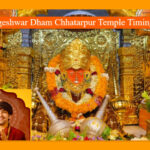
At Samarlakota Kumararama Bhimeswara Swamy Temple, in Andhra Pradesh’s Kakinada district, the central object of worship does something genuinely unusual for a Shiva Linga: it does not simply stand within a single sanctum, but rises from a pedestal on the ground floor, pierces directly through the roof, and continues upward into a second-floor chamber, where its upper portion — the Rudrabhaga — is worshipped separately. The Linga itself, carved from white limestone, stands approximately 14 to 16 feet tall (sources show minor variation), making this one of the most architecturally distinctive Shiva sanctums anywhere in the Pancharama tradition.
The legend explaining this Linga’s origin connects Samarlakota directly to the same mythological cycle behind several other temples covered in this guide. According to the Skanda Purana, the demon king Tarakasura had obtained an Atma Linga (Prana Linga) during the churning of the cosmic ocean, wearing it as a personal amulet that rendered him effectively invincible. Lord Kumara Swamy (Kartikeya), son of Shiva and Parvati and commander of the celestial army, faced Tarakasura in battle and repeatedly broke his body apart — only to watch it reunite each time. Confused, Kumara Swamy sought Lord Vishnu’s counsel, who explained the actual solution: the demon’s invincibility came specifically from the Atma Linga itself, and only by breaking that object — not the demon’s body — could the threat be permanently resolved. Vishnu added a crucial warning: even the Linga’s broken fragments would try to reunite by chanting “Om” unless each piece was immediately consecrated and worshipped exactly where it fell.
Using his Agni weapon, Kumara Swamy shattered the Atma Linga into five pieces — and, following Vishnu’s instruction, the gods Indra, Surya, Chandra, Vishnu, and Kumara Swamy himself each took responsibility for worshipping one fragment at the exact spot it landed, preventing reunification. Kumara Swamy’s own fragment fell at this site, and he personally installed and consecrated the Linga here — giving the temple its name: Kumararama, “the abode established by Kumara.” This is why Samarlakota is one of the five Pancharama Kshetras, sharing its origin story directly with Draksharamam, Mopidevi (Andhra’s broader Tarakasura-Atmalinga tradition), and the temple’s three other sibling sites.
💡 Quick Answer Darshan timings: 6:00 AM – 12:00 PM and 4:00 PM – 8:00 PM daily; on Maha Shivaratri, the temple remains open continuously 6:00 AM – 8:00 PM Entry: Completely free; no special darshan facilities or VIP tier exist Built: Late 9th–early 10th century CE, by Eastern Chalukya King Bhima I (892–921/922 CE) National Heritage status: A centrally protected monument of national importance Pancharama circuit tour: APSRTC runs a 24-hour, ~700 km circular bus tour covering all five Pancharama Kshetras, departing 8:00 PM every Sunday, approximately ₹350 including darshan charges A note on condition: Several sources specifically note parts of the temple are in poor condition, with ongoing government renovation work Last Verified: June 2026
Samarlakota Kumararama Temple Timings 2026
| Activity | Timing |
|---|---|
| Morning darshan | 6:00 AM – 12:00 PM |
| Afternoon closure | 12:00 PM – 4:00 PM |
| Evening darshan | 4:00 PM – 8:00 PM |
| Maha Shivaratri (continuous, no break) | 6:00 AM – 8:00 PM |
| Suprabhata Seva / Nitya Archana | Starts around 6:30 AM |
| Daily Abhisheka (Nov–Dec, Karthika and Margashira months) | Performed daily during this specific period |
Pro tip: This temple’s timing is one of the more consistently confirmed schedules across the sources researched for this guide — multiple independent sources, spanning several years, converge on the same 6:00 AM–12:00 PM and 4:00 PM–8:00 PM pattern, making it a relatively reliable schedule to plan around compared to several other temples in this series.
A Note on Current Temple Condition and Ongoing Renovation
This deserves honest mention: multiple sources specifically note that several parts of the temple are in poor structural condition, with ongoing renovation work overseen by the Government of Andhra Pradesh. A garden is reportedly also being developed alongside this renovation effort, intended to give visitors an additional picnic-style space within the broader temple grounds. If a pristine, fully restored monument is specifically what you are seeking, set expectations accordingly — Samarlakota’s significance rests substantially in its history, mythology, and the genuine antiquity of its construction, rather than in flawless modern upkeep.
The APSRTC Pancharama Circuit Tour — See All Five Temples in 24 Hours
For devotees specifically wanting to complete the entire Pancharama Kshetra pilgrimage in a single, efficiently organized trip, the Andhra Pradesh State Road Transport Corporation (APSRTC), Kakinada Depot, operates a dedicated circular tour covering all five temples — Amaravathi, Bhimavaram, Palakollu, Draksharama, and Samalkota — in a single continuous journey.
Schedule: Departs 8:00 PM every Sunday, returning by 8:00 PM the following day.
Distance: Approximately 700 km (430 miles) covered across the full circuit.
Cost: Reported at approximately ₹350, inclusive of darshan charges at each respective temple along the route.
Pro tip: This tour is specifically useful for pilgrims with limited time who want to complete the full five-temple Pancharama circuit efficiently — confirm current departure point, exact pricing, and booking process directly with APSRTC’s Kakinada Depot before planning around this specific service.
What Is Kumararama — Architecture and Sub-Shrines
Built by Chalukya Bhima I, Commemorating 300+ Battle Victories
The temple’s construction is attributed to the Eastern Chalukya King Bhima I, reigning between 892 and 921/922 CE, who is specifically credited with commissioning the temple to commemorate his victories in over 300 wars — making this one of relatively few major Indian temples whose founding is directly tied to a specific, documented count of military triumphs rather than purely devotional motivation alone.
A Twin to Draksharamam
The temple’s architecture closely resembles its sibling Pancharama site at Draksharamam, also called Bhimeswara Alayam — both built in classical Dravidian style, with strikingly similar layouts, leading multiple sources to describe Samarlakota as architecturally “twin” to the more widely known Draksharamam.
Surya Dwaram — The Main Entrance
The temple’s main entrance is specifically named Surya Dwaram (“Gate of the Sun”), reflecting the broader Navagraha-adjacent symbolism connecting this Pancharama site to the wider mythological framework involving Surya, Chandra, and the other deities who took responsibility for the scattered Atma Linga fragments.
Two Prakara Walls of Dressed Sandstone
The temple complex is enclosed by two Prakara (boundary) walls, constructed of carefully dressed sandstone, with the outer wall featuring entrances facing all four cardinal directions.
A Mandapam Supported by 100 Pillars
A significant architectural feature within the complex is a mandapam (hall) supported by 100 pillars, several of which bear intricate carvings of Apsaras (celestial dancers) — the Kakatiya dynasty, ruling in a later period (roughly 1340–1466 CE), specifically added and renovated many of these pillars, with their finer, more polished finishing work easily distinguishable from the earlier Chalukya-era stonework.
Ekasila Nandi — Carved From a Single Stone
A distinctive Nandi (sacred bull) statue, carved entirely from a single block of stone (Ekasila), stands at the temple entrance, positioned directly opposite the Shiva Linga in the traditional configuration.
Goddess Bala Tripura Sundari
The temple’s presiding goddess is Bala Tripura Sundari, worshipped alongside the central Bhimeswara Linga — with additional shrines for Ganapati, Subrahmanya (Kumara Swamy himself), the Navagrahas, and Vishnu and other deities completing the broader devotional complex.
Inscriptions Spanning Centuries
Sasanas (inscriptions) dated between 1147 and 1494 CE are recorded on the temple’s pillars, documenting centuries of gifts and donations made to the temple across this extended historical period — a genuinely valuable, continuous historical record carved directly into the structure itself.
A Nearby Mandavya Narayana Swamy Temple
Close to the main Shiva temple stands the Mandavya Narayana Swamy Temple, where, according to local legend, the sage Madhavya performed tapas and received darshan of Lord Narayana — with Indra himself said to have visited this specific spot aboard his Pushpaka Vimana specifically to have darshan of the sage. A separate, partially buried Trimukha Lingam Temple nearby houses a three-faced Linga (representing the Trimurti — Brahma, Vishnu, Shiva), with only its upper 14-foot portion currently visible above ground.
Festivals at Kumararama Temple
Maha Shivaratri (Magha month): The temple’s most grand celebration, drawing thousands of devotees, with a car (chariot) festival specifically held during this period.
Kalyana Mahotsavam (Magha Bahula Ekadashi, February–March): A significant Utsavam (festive celebration) marking a specific divine wedding observance.
Daily Abhisheka (Karthika and Margashira months, November–December): A sustained, daily ritual observance specific to this two-month period.
The Trap — What Catches Most Visitors
“Expected a fully restored, pristine monument” → Cause: Underestimating that several sources specifically note ongoing renovation and parts of the temple in poor condition → Fix: Approach the visit with appropriate expectations — Samarlakota’s value lies substantially in its history and mythology, alongside active, ongoing government restoration efforts.
“Arrived during the 12:00 PM–4:00 PM closure” → Cause: Standard daily afternoon break → Fix: Plan your visit for 6:00 AM–12:00 PM or 4:00 PM–8:00 PM specifically, except on Maha Shivaratri, when the temple remains open continuously.
“Missed the upper Rudrabhaga portion of the Linga” → Cause: Not realizing the Linga extends to a second floor → Fix: Use the stairs available on both sides of the structure specifically to view the Rudrabhaga (the Linga’s upper portion) on the first/second floor, in addition to the ground-floor darshan.
“Assumed VIP or special darshan existed” → Cause: Comparing this temple to larger sites with formal priority-access systems → Fix: There are no special darshan facilities at Kumararama — all visitors perform the same general, completely free darshan.
How to Reach Samarlakota Kumararama Temple
Temple address: Samarlakota (Samalkota), East Godavari/Kakinada District, Andhra Pradesh — 533440.
By road: Approximately 15 km from Kakinada, 49–52 km from Rajahmundry, and 125 km from Visakhapatnam.
By train: Samalkot Junction (SLO), a major station on the Howrah–Chennai broad-gauge main line, is just 1–1.5 km from the temple — among the most directly rail-accessible major temples in this entire guide, with the temple reportedly visible right beside the station itself.
By air: Rajahmundry Airport — approximately 46–50 km, the nearest air gateway. Visakhapatnam Airport — approximately 156–160 km, an alternate option.
Accommodation: Budget hotels are available directly in Samalkota; a wider range of options exists in nearby Kakinada or Rajahmundry.
Before You Visit Samarlakota Kumararama Temple — Checklist
☑ Darshan timings confirmed — 6:00 AM–12:00 PM and 4:00 PM–8:00 PM, continuous on Maha Shivaratri ☑ Realistic expectations set regarding temple condition, given ongoing renovation noted across sources ☑ Both ground-floor and upper Rudrabhaga darshan planned, using the stairs available on either side ☑ APSRTC Pancharama circuit tour considered if planning to visit all five Pancharama Kshetras efficiently ☑ Modest, traditional dress worn ☑ Draksharamam, Annavaram, and Rajahmundry considered for a combined Konaseema/East Godavari circuit ☑ October–March travel preferred for comfortable weather
Frequently Asked Questions
What are Samarlakota Kumararama Temple darshan timings in 2026?
The temple is open daily from 6:00 AM to 12:00 PM and 4:00 PM to 8:00 PM. On Maha Shivaratri, it remains open continuously from 6:00 AM to 8:00 PM without the usual afternoon break.
What is the legend behind Kumararama Temple’s name?
According to the Skanda Purana, the demon Tarakasura wore an invincible Atma Linga around his neck. Lord Kartikeya (Kumara Swamy) shattered this Linga into five pieces on Lord Vishnu’s advice, and each piece was consecrated where it fell to prevent the fragments from reuniting. Kumara Swamy personally installed and consecrated the fragment that fell at this specific site, giving the temple its name, Kumararama.
Why does the Shiva Linga at this temple pierce through the roof?
The 14-16 foot limestone Linga rises from a ground-floor pedestal and extends into a second-floor chamber, where its upper portion (the Rudrabhaga) is separately worshipped — a distinctive two-storey sanctum design unique among Pancharama temples.
Who built Samarlakota Kumararama Temple?
The Eastern Chalukya King Bhima I, reigning 892–921/922 CE, commissioned the temple, reportedly to commemorate his victories in over 300 wars.
Is the temple in good condition?
Multiple sources specifically note that several parts of the temple are in poor structural condition, with ongoing renovation overseen by the Government of Andhra Pradesh. Set realistic expectations accordingly.
What is the APSRTC Pancharama circuit tour?
A 24-hour circular bus tour operated by APSRTC’s Kakinada Depot, covering all five Pancharama Kshetras (Amaravathi, Bhimavaram, Palakollu, Draksharama, and Samalkota) across approximately 700 km, departing 8:00 PM every Sunday and returning by 8:00 PM the next day, at approximately ₹350 including darshan charges.
How far is Samarlakota Kumararama Temple from the railway station?
Just 1–1.5 km from Samalkot Junction (SLO), a major station on the Howrah-Chennai broad-gauge line — among the most easily rail-accessible temples covered in this guide.
Contact and Help
Address: Samarlakota, East Godavari/Kakinada District, Andhra Pradesh — 533440 Maintained by: Government of Andhra Pradesh Pancharama circuit tour: APSRTC, Kakinada Depot
One Last Thing
A demon’s invincibility, broken into five pieces specifically so it could never reassemble, scattered across what is now Andhra Pradesh and consecrated, piece by piece, by five different gods at the exact spots where each fragment landed — this is the founding logic behind an entire regional network of temples, Samarlakota among them, each one a kind of permanent anchor holding a fragment of something dangerous safely in place.
The Linga here does something almost literal with that mythology: it does not stay contained in a single sanctum the way most temple deities do, but pushes upward through its own roof, refusing to be fully held within one floor of stone — as though even now, centuries after Kumara Swamy’s Agni weapon did its work, this particular fragment still carries some restless quality the architecture itself had to accommodate rather than contain. Climb the stairs on either side. The Rudrabhaga waits above, the same Linga continuing where the ground floor’s darshan leaves off.
Om Namah Shivaya. Jai Bhimeswara. Jai Kumara Swamy.